



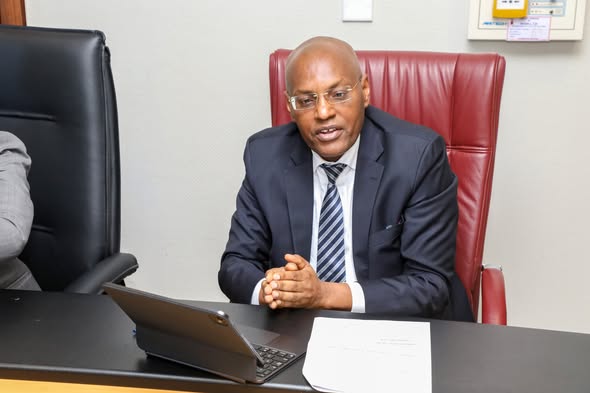
The Deputy Governor of the Bank of Tanzania (BoT) in charge of Economic and Financial Policies, Dr. Yamungu Kayandabila, has stated that the national payment systems play a significant role in promoting inclusive economic growth and strengthening financial inclusion in the country.
Delivering welcome remarks to Master of Business Administration (MBA) students from Stanford University, United States of America, during their visit to the Bank of Tanzania (BoT) in Dar es Salaam on 27 March 2026, Dr. Kayandabila explained that payment systems contribute to inclusive economic growth and inclusive finance by enabling payments and settlements, which fuel supply chains in the economy and act as the backbone of the Financial Sector Stability.
He noted that efficient, secure, and inclusive payment systems enhance the effectiveness of monetary policy by enabling better transmission of central bank interest rate changes and strengthening liquidity management within the economy.
Dr. Kayandabila added that the Bank of Tanzania has continued to take various policy measures and invest in infrastructure to strengthen and improve payment systems, while also promoting innovation, particularly in digital financial services and financial inclusion.
Explaining the history of these improvements, he said the modernization of payment systems began in the mid-1990s as part of broader financial sector reforms aimed at improving efficiency, security, and stability of the financial system.
He further noted that these reforms facilitated the entry of private domestic and international banks, the privatization of some state-owned banks, and the removal of certain restrictions on financial services and products.
According to Dr. Kayandabila, in 1996, BoT launched the National Payment Systems Reform Project, which aimed to transform the old system that relied heavily on cash and paper-based processes into an electronic system aligned with international standards.
He recalled that before these reforms, cash transactions dominated, while cheque processing could take up to 14 days in upcountry regions and 7 days in Dar es Salaam, causing delays in economic activities.
He also emphasized that BoT continues to monitor global developments in payment technologies and collaborates with regional and international stakeholders to benefit from such innovations, while safeguarding financial sector stability, system integrity, and consumer interests.
On her part, the Director of National Payment Systems, Ms. Lucy Shaidi, highlighting key milestones achieved up to 2025, said there has been rapid growth in instant payments, mobile financial services, and interoperable payment systems. She noted that these developments are driving Tanzania towards a more inclusive, efficient, and increasingly digital financial system.
Among the major achievements of the Bank of Tanzania in payment systems is the establishment of the Tanzania Instant Payment System (TIPS), which allows users of financial services to send and receive money instantly, regardless of the financial institution they use. TIPS has improved efficiency, reduced transaction costs, and strengthened financial inclusion by simplifying financial transactions for individuals and businesses across Tanzania.