



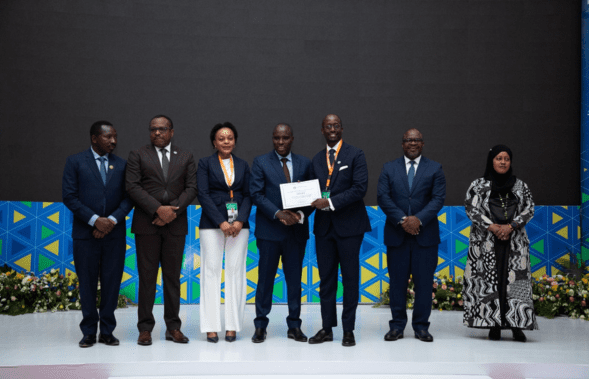
Stanbic Bank Pledges Cooperation with the Government Towards the Vision 2050 Development Agenda
- Tanzania’s leaders and business executives have called for stronger reforms and public–private collaboration to make state-owned enterprises more competitive globally.
- Stanbic Bank executives urged the creation of financial pathways and investment frameworks that mobilise local capital to drive transformation.
- The Vice President, Treasury Registrar, and Stanbic leaders all highlighted that sustainable synergies are essential for Tanzania’s long-term growth and competitiveness.
Arusha, 25 August 2025 – Mobilising local capital and building stronger financial pathways for state-owned enterprises (SOEs) must be a national priority if Tanzania is to succeed in an increasingly competitive global economy, Stanbic Bank Tanzania executives told delegates at the Chairpersons and CEOs Forum 2025.

Ester Manase Lobore, Executive Director and Head of Corporate & Investment Banking at Stanbic Bank Tanzania, described the Forum as a critical bridge between public and private sectors. “As we mark our participation in this Forum, we see it as an opportunity to build a new bridge of cooperation – one that connects the public and private sectors for the benefit of our nation,” she said.
Lobore noted that in the past five years Stanbic had channelled more than USD 1 billion in affordable financing into strategic projects, reinforcing the role of financial institutions in aligning investment with national priorities.
Manzi Rwegasira, Chief Executive of Stanbic Bank Tanzania, emphasised that true transformation requires SOEs and private institutions to leverage one another’s strengths. “SOEs provide the foundation – energy, infrastructure, services. The private sector brings capital, innovation and expertise. It is at this intersection where true transformation happens,” he said.
Rwegasira added that future competitiveness depends on three focus areas: financing transformative projects, digitising systems for efficiency and transparency, and building institutional capacity through technical expertise.
The Guest of Honor, Deputy Prime Minister, Hon. Dr. Doto Biteko, emphasized the importance of the six (6) resolutions evaluated by the Treasury Registrar last year, noting that 90% of them had been successfully implemented. “A bridge like this serves as a classroom for us to educate others. In addition, a Dashboard will be introduced to monitor the performance of Public Institutions. Statistics show that in 2024, it was resolved that every institution should enhance its performance and increase its contribution to the National Treasury,” he said.
Treasury Registrar Nehemia Mchechu, who convened the Forum, launched the Performance Monitoring Dashboard for Public Institutions, a digital tool that allows real-time tracking of SOE performance. “Through the Performance Monitoring Dashboard, the Office of the Treasury Registrar will be able to track revenue, access data in real time and evaluate performance without physically visiting institutions,” he said.
Now in its third edition, the Chairpersons and CEOs Forum has established itself as a premier platform for dialogue on SOE reform and competitiveness. This year’s discussions made clear that sustainable synergies require both government reforms and private sector engagement.
For Stanbic Bank Tanzania, which participated as a Resilience Sponsor, the event underlined the bank’s role in supporting national priorities — not only through financing, but also by contributing perspectives on how SOEs and private institutions can work together to secure Tanzania’s place in the global economy.