



By our Special Respondent in Busan, Korea
The 48th Session of the UNESCO World Heritage Committee concluded in BEXCO, Busan, Republic of Korea, on July 29, 2026. The historic 10-day meeting approved 28 total property actions, adding 25 new sites to the World Heritage List and bringing total World Heritage properties to 1,273. Delegates from 196 States Parties to the World Heritage Convention of the United Nations Educational, Scientific and Cultural Organization (UNESCO) and UNESCO’s advisory bodies ICOMOS and IUCN are attending the 48th session of the UNESCO World Heritage Committee (WHC).
Approximately 3,000 delegates, including the Director-General of UNESCO, representatives from Member States, Ministerial-level officials and Deputy Ministers from 21 member states that constitutes the World Heritage Committee attended the session.
The Permanent Mission of Tanzania to UNESCO in collaboration with the UNESCO National Commission of the United Republic of Tanzania organized a side event to brief UNESCO Member States from around the world on the findings of the two Presidential Commissions that conducted an assessment of land issues and voluntary relocation from the Ngorongoro Conservation Area.
The reporter also received further clarification from Prof. Hamisi Malebo, Executive Secretary of the UNESCO National Commission of the United Republic of Tanzania, that the side event is an effort by the Government to respond to calls that have been made by various United Nations Experts, UNESCO advisory bodies and organizations requesting the Government to publish the results and full report of the Presidential Commissions that conducted an assessment of land issues and voluntary relocation from the Ngorongoro Conservation Area.
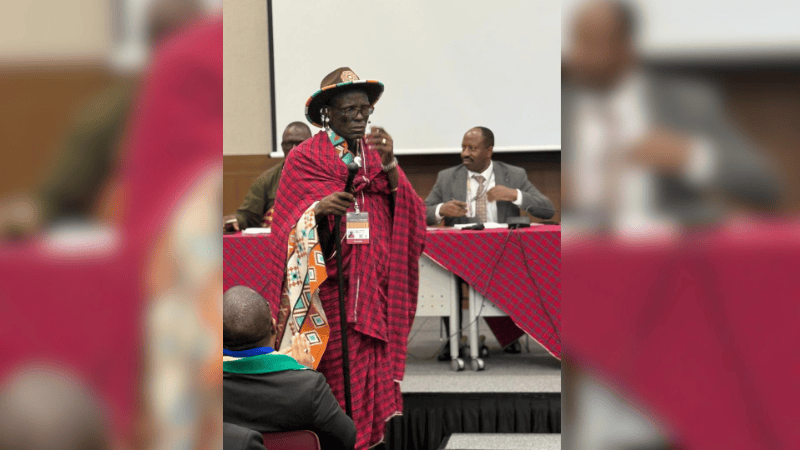
Contributing to the discussion during the Ngorongoro Side Event at the 48th Session of the UNESCO World Heritage Committee, Mr. Isack Lekisongo Meijo, a Maasai Traditional Leader from Tanzania, underscored the historic relationship between the Maasai people, livestock and wildlife within the Ngorongoro Conservation Area (NCA). Mr. Meijo emphasized that traditional Maasai pastoralism has, for generations, coexisted with wildlife though with difficulties attributable to human wildlife interactions, but have contributed to the conservation of the Ngorongoro ecosystem.
He said, “there is no Ngorongoro without the Maasai pastoralists, and there is no Ngorongoro without the wildlife.” Using a powerful metaphor to illustrate the challenge of balancing conservation and human development, he stated: “Ngorongoro is like an aircraft carrying pastoralists, livestock and wildlife. Today, the aircraft is fully loaded, indeed overloaded. If it attempts to take off carrying more than its safe capacity, it risks crashing. For a safe and sustainable journey, it must offload its excess luggage in a carefully planned and balanced manner.”
Mr. Meijo explained that the metaphor reflects the growing pressures on the finite ecosystem of the Ngorongoro Conservation Area, where increasing human populations, human settlements, livestock and wildlife coexist within the same landscape which is not expanding under the Multiple Land Use Model (MLUM). He observed that the international discussion on achieving an appropriate balance between conservation and sustainable human development has generated differing perspectives.
One school of thought advocates reducing pressure on the ecosystem through the voluntary relocation of pastoralist households and their livestock to areas with expanded social and economic opportunities. Another perspective argues for relocating wildlife to other areas beyond the Conservation Area to reduce ecological pressure. The MLUM in the NCA faces severe sustainability strains as growing human populations, livestock, and wildlife share a fixed land size which at the moment it has taken a collapsing gravity, and this is a wake-up call to rescue Ngorongoro.
Mr. Meijo stressed that, regardless of differing views, the common objective is to safeguard the Outstanding Universal Value of the Ngorongoro Conservation Area while ensuring sustainable livelihoods for present and future generations of the Maasai community. He concluded by reaffirming the commitment of the Maasai community to continue working with the Government of Tanzania, UNESCO, IUCN, ICOMOS and all stakeholders to ensure that Ngorongoro remains a globally significant World Heritage Site where conservation, culture and sustainable development reinforce one another.
Following immediately after Mr. Meijo’s call, a delegate from Zimbabwe questioned and wanted to know at the operation level between the two, which option carries more risks between the relocation of pastoralists and their livestock or relocating wildlife from Ngorongoro Conservation area to reduce ecological pressure? Responding to the question on behalf of the Government of the United Republic of Tanzania, Prof. Hamisi Malebo, the Executive Secretary of the UNESCO National Commission of Tanzania, told the meeting that the easiest option is to educate and request for voluntary relocation and that can only be done with humans.
Prof. Malebo told the meeting further that, relocating wild animals is far more complex and dangerous than moving human populations, involving immense logistical hurdles, severe financial costs, and the permanent disruption of ancient, finely-tuned natural phenomena, the seasonal movement of over 1.5 million wildebeest. He reiterated the position of the Government of the United Republic of Tanzania which on the same reasons is relocating Maasai pastoralists outside of the Ngorongoro Conservation Area.
Delegates and representatives from 36 countries expressed gratitude to the Government of the United Republic of Tanzania for hosting an informative side event on the Ngorongoro Conservation Area during the 48th Session of the UNESCO World Heritage Committee in Busan, South Korea. Contributions from the majority of the delegates conceded that, maintaining balance in the Ngorongoro Conservation Area is complex due to soaring human populations, wide spreading human settlements, rising livestock numbers, and shrinking wildlife grazing space and corridor.
The mixed land-use model is unsustainable due to severe pressure from overgrazing, human-wildlife conflicts, and climate change. The event brought together Permanent Delegates to UNESCO, International Ambassadors, Members of the World Heritage Committee, Maasai Traditional Leaders, Conservation Experts, The Pastoralists Indigenous Non-Governmental Organizations Forum (PINGOs Forum), the Maasai International Solidarity Alliance (MISA) and other stakeholders to discuss the future of the Ngorongoro Conservation Area.
On his opening remarks Ambassador His Excellence Saidi Yakubu, The Permanent Representative of Tanzania to UNESCO and Ambassador of Tanzania to France, stressed that sustainable conservation requires openness, honest talks, and teamwork. The session highlighted collaborative efforts with UNESCO and the IUCN to align ecological preservation with the welfare of local communities.