




Tanzanian traders importing from China can now pay suppliers directly from their Tanzanian Shilling accounts, removing the need to first convert funds into US dollars before settlement in Chinese Yuan.
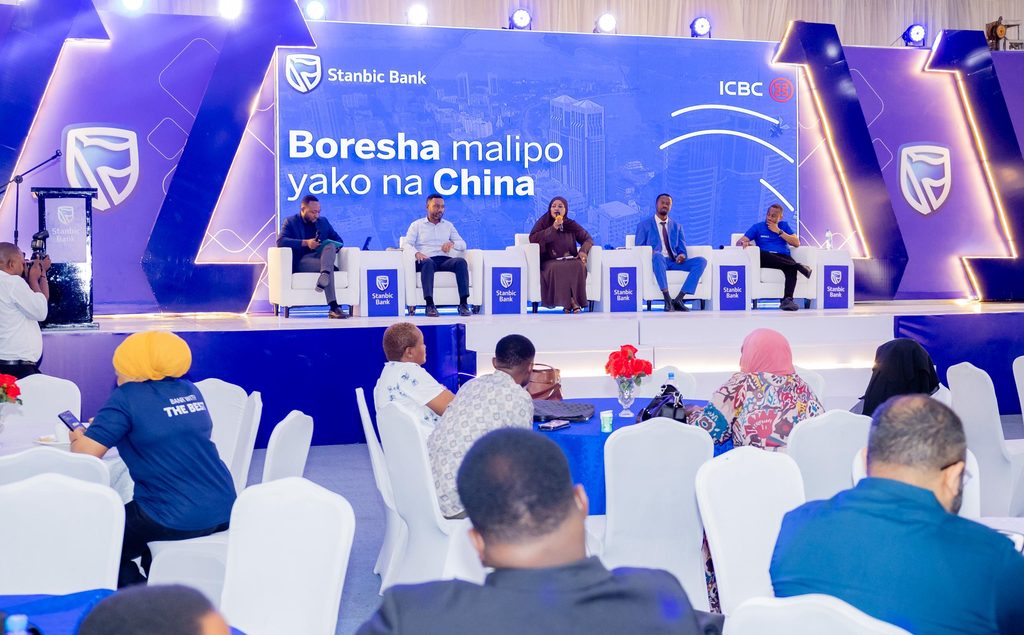
The new payment route was highlighted at a Tanzania-China business forum hosted by Stanbic Bank Tanzania at Diamond Jubilee Hall in Dar es Salaam, bringing together Tanzanian traders, Chinese business representatives, government and trade institutions to discuss opportunities for strengthening trade and investment between the two markets.
Dar es Salaam businesswoman Lulu Kheri, who has been importing from China for several years, welcomed the solution, saying exchange-rate movements and informal payment arrangements have long affected traders’ costs and margins.
“We traders look at the rate because we look at profit. Someone can quote you one rate in the morning and by midday the rate has changed. Sometimes you take a lower informal rate and then you are left worrying whether the money will reach your supplier. Many traders have lost money that way,” Kheri said.
She said the direct Shilling-to-Yuan solution gives traders a simpler and more predictable formal route for paying suppliers.
“What matters to us is the rate, the cost and knowing the supplier will be paid. If I can put my Shillings into my Stanbic account and the Chinese supplier gets paid without an additional transfer charge, that speaks directly to the needs of traders,” Kheri said. “When money is being reduced at every stage of a transaction, eventually it affects your profit.”
The forum showcased Stanbic Bank Tanzania’s direct Tanzanian Shilling-to-Chinese Yuan payment solution, launched on 12 August 2026, making Stanbic the first bank in Tanzania to enable customers to pay Chinese suppliers directly from a Shilling account and receive payments from China through the same route.
The service is enabled through the Cross-Border Interbank Payment System, CIPS. By removing the need to convert Shillings into US dollars before converting to Yuan, the solution removes one currency conversion and reduces the number of parties involved in a payment. Eligible transactions can settle within minutes, subject to normal banking requirements and operating hours.
Fredrick Max, Head of Business and Commercial Banking at Stanbic Bank Tanzania, said the route addresses a long-standing challenge for businesses trading with China.
“For businesses trading with China, the payment process has traditionally involved converting Shillings into US dollars and then into Yuan. Our direct Shilling-to-Yuan solution removes that extra step, helping customers save time, manage costs and transact more efficiently,” Max said.
Direct settlement also gives businesses greater control over their foreign exchange planning while reducing reliance on informal money-changing arrangements, cash handling or unnecessary travel to make payments, with Stanbic Bank Tanzania applying no transfer charge on direct Yuan payments through 31 December 2026.
Max said the bank’s ambition goes beyond the transaction. Stanbic Bank Tanzania is part of Standard Bank Group, which has a strategic relationship with the Industrial and Commercial Bank of China, ICBC. Through this network, the bank helps Tanzanian businesses identify credible suppliers, build direct commercial relationships in China and reach Chinese buyers, including through platforms such as the China International Import Expo.
“We want to do more than move money to China. We want to help Tanzanian businesses build the right connections, find credible suppliers and reach new buyers for Tanzanian products,” Max said.
That theme continued during a panel discussion at the forum, “Fursa Kati ya Soko la Tanzania na China”, Opportunities in the Tanzania-China Market, which examined how traders, exporters and investors can use the new payment route alongside existing trade and investment support.
Alfred Ngelula, Head of the China Desk at the Tanzania Investment and Special Economic Zones Authority, TISEZA, said reducing the cost of moving capital between Yuan and Shillings strengthens Tanzania’s proposition to Chinese investors.
“When an investor brings capital in Yuan, it has traditionally had to pass through the dollar before becoming Shillings. Take away that additional cost and you reduce the cost of investing,” Ngelula said. “That is important for an investor because it improves competitiveness and gives us another strong reason to tell Chinese investors that Tanzania is the right place to invest.”
Benson Nkini, Seniro Trade officer at the Tanzania Trade Development Authority, TanTrade, said Tanzania should use its growing relationship with China to increase exports while placing greater emphasis on locally processed products.