



Rwegasira: SMEs hold key to Tanzania’s economic future
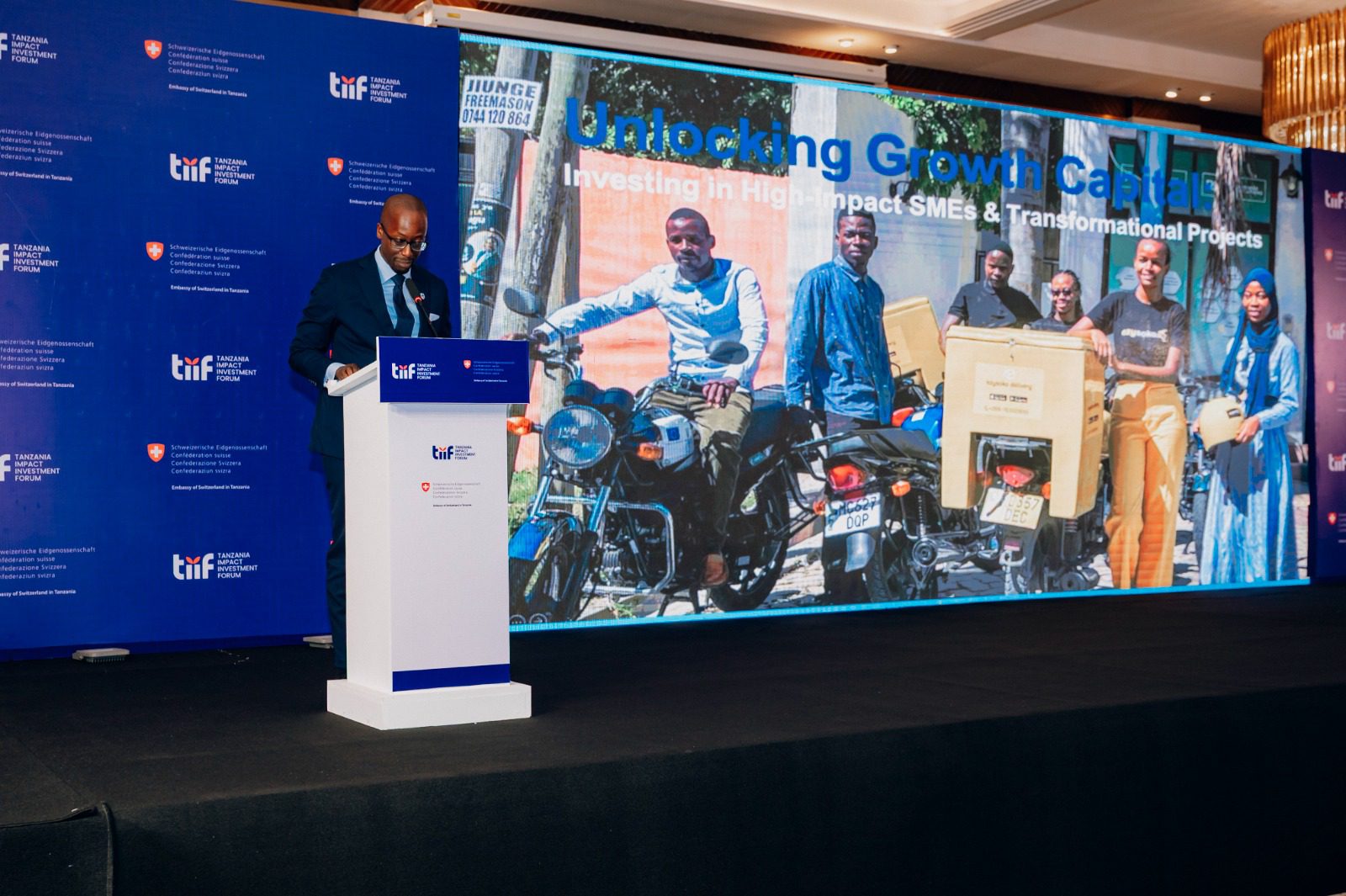
The future of Tanzania’s economic transformation will depend not merely on attracting investment but on unlocking capital already waiting to be deployed, according to Stanbic Bank Tanzania Chief Executive Officer Manzi Rwegasira.
Addressing investors, development finance institutions, entrepreneurs and government representatives at the Tanzania Impact Investment Forum (TIIF), Rwegasira argued that the country stands at a pivotal moment in its economic journey, with youthful demographics, growing investor interest and an expanding ecosystem of impact funds creating unprecedented opportunities for growth.
Yet he warned that optimism alone would not guarantee success.
“Unlocking growth capital implies that the value, the opportunity and the capital are already there,” he told delegates. “The challenge is finding the right key to open the door.”
The forum brought together stakeholders from across the investment landscape, including representatives from Switzerland, the United Kingdom, development finance institutions and private investors seeking opportunities in Tanzania’s growing economy.
A country of opportunity
Rwegasira painted a picture of a nation whose greatest asset is its people. With more than 60% of Tanzanians under the age of 25, he described the country’s youth population as “the largest concentration of ambition, energy and unmet demand on this part of the continent”.
But he argued that the real engine of growth lies in small and medium-sized enterprises (SMEs), which he described as the businesses where Tanzania’s economic future will ultimately be built.
“The SME is where this country’s growth will actually happen,” he said. “Not in a headline, but in workshops, clinics, cold-storage facilities and fleets of motorbikes.”
He pointed to initiatives such as the Daraja Impact Fund and the Funguo programme as examples of how catalytic funding can unlock private-sector growth by reducing risk and attracting larger pools of commercial capital.
Among the examples highlighted was MazaoHub, a Tanzanian agritech company that received an initial $50,000 in catalytic funding to develop a soil-testing kit. The company later secured a $2m pre-seed investment round after refining its technology and proving its business model.
“That is what unlocking growth capital looks like,” Rwegasira said. “A relatively small investment can become the foundation for something much larger.”
The power of perception
While acknowledging Tanzania’s positive momentum, Rwegasira devoted a significant portion of his remarks to the role perception plays in shaping investment flows.
He referenced three contrasting magazine covers published by The Economist over nearly two decades: the infamous “Hopeless Continent” cover in 2000, the optimistic “Africa Rising” cover in 2011, and the “New Scramble for Africa” cover in 2019.
The covers, he argued, reflected how narratives influence investor behaviour.
“The people did not suddenly become more capable,” he said. “What changed was the narrative. Narrative shapes perception. Perception shapes risk assessment. Risk assessment determines where capital flows and on what terms.”
According to Rwegasira, the lesson for African economies is that perception carries a real financial cost. Countries viewed as risky pay more for capital, while those seen as stable and promising attract investment more easily.
A warning against overselling impact
Despite the optimism surrounding impact investing, Rwegasira urged investors and development partners to be more rigorous in measuring outcomes.
He challenged the sector to confront a difficult question known as “additionality” — whether positive outcomes would have occurred without the intervention of impact capital.
“Did your investment create the change, or did it simply accompany it?” he asked.
Drawing on evidence from decades of microfinance programmes around the world, he noted that many initiatives produced positive but often modest results when subjected to rigorous evaluation.
While impact investing has demonstrated an ability to generate competitive returns, he argued that the industry must become better at proving the social and economic outcomes it claims to deliver.
“If we promise transformation and deliver only marginal gains, we risk losing the one asset that cannot easily be rebuilt: trust,” he said.
He called for greater investment in long-term monitoring, data collection and evidence-based evaluation, describing these as the foundations upon which the credibility of the impact-investment industry will ultimately rest.
The challenge of the ‘missing middle’
Central to Rwegasira’s address was the challenge facing many promising Tanzanian businesses as they attempt to grow.
Too often, he said, SMEs find themselves trapped in what investors call the “missing middle” — businesses that have progressed beyond grant funding but remain too risky or unstructured to secure conventional bank financing.
According to Rwegasira, the problem is not only a lack of capital but also a lack of readiness.
“Many SMEs are not unfundable because the idea is weak,” he said. “They are unfundable because they have not yet built the systems, governance and financial discipline required to attract investment.”
He cited the Stanbic Business Incubator as an example of efforts to address this challenge by helping entrepreneurs formalise their businesses, strengthen governance structures and prepare for investment.
The CEO also highlighted the experience of Simplify, a Tanzanian technology company that develops digital tax compliance and accounting solutions for SMEs. Early support from the Funguo programme, he said, helped build confidence among investors and opened the door for additional funding from international development institutions.
Banks must do more than lend
For banks, Rwegasira argued, supporting economic transformation requires more than simply providing loans.
Financial institutions, he said, have a responsibility to bridge the gap between catalytic funding and large-scale commercial investment by structuring finance solutions that help businesses grow from small enterprises into major economic players.
This includes blended finance models that combine grants, concessional funding and commercial capital, allowing investors to manage risk while scaling successful ventures.
At the same time, he stressed the importance of financing transformational infrastructure projects capable of reshaping entire sectors of the economy.
“The high-impact SME and the transformational project are two ends of the same mandate,” he said. “A serious financial system must support both.”
A call for collective action
Rwegasira concluded by challenging every stakeholder in the investment ecosystem to play their part.
He urged investors to demand stronger evidence of impact, entrepreneurs to build investment-ready businesses, development partners to continue taking early-stage risks, and governments to create stable and predictable regulatory environments.
“Capital is a coward,” he said. “It flees uncertainty and moves towards confidence.”
For Tanzania, he argued, the opportunity is clear but not guaranteed.
“The capital is here. The entrepreneurs are here. The tools exist. What is not guaranteed is that the door remains open forever,” he said.
“Our task is not to stand at the door and describe it. Our task is to turn the key and unlock Tanzania’s growth.”